Go to section...

  1. What an EC Motor Is and How It Differs from an AC Motor
  2. Key advantages of an EC motor for the consumer compared to an AC one
  3. When is AC enough?
  4. Which to Choose
  5. VENTS EC Fan Series

If you have ever bought a residential fan for your bathroom, kitchen, or restroom, you’ve probably noticed that models with similar designs and specifications can vary significantly in price. One reason for this is the type of motor used in the fan. In the product specifications, this is denoted as AC or EC.

Let’s break down in simple terms what these labels mean, how AC and EC differ, and which option to choose for your needs.

What an EC Motor Is and How It Differs from an AC Motor


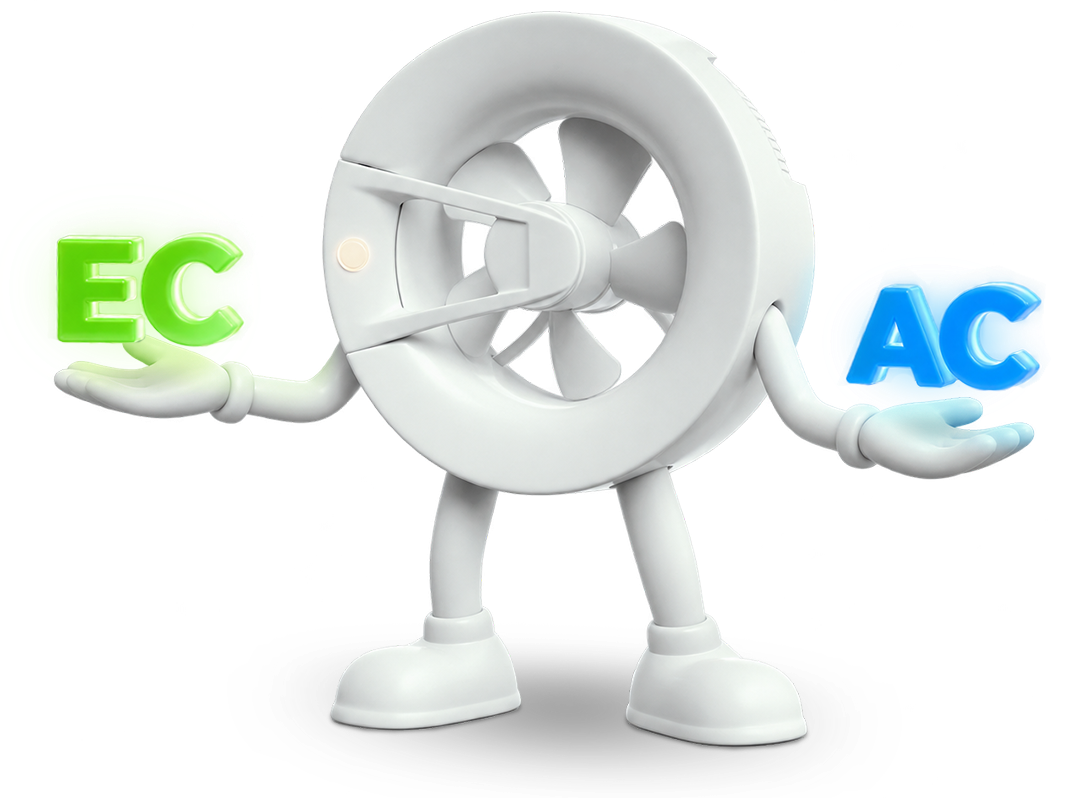
EC

Electronically Commutated

Is an electronically commutated motor with permanent magnets and built-in control electronics. It is an advanced solution that combines low power consumption with high performance. 


AC

Alternating Current

Is a traditional alternating-current motor widely used in residential fans. Unlike an EC motor, its operating principle is determined by the parameters of the electrical grid. At the same time, the efficiency of AC motors is typically lower than that of modern EC motors, meaning that under the same operating conditions, they can consume more electricity. 


Key advantages of an EC motor for the consumer compared to an AC one

Reduced Power Consumption

An EC motor features significantly higher efficiency compared to residential AC motors of the same size. As a result, for the same airflow performance, the fan consumes considerably fewer watts of power—especially under partial loads, which are typical for continuous background ventilation at reduced speeds.

Quiet Operation
The EC motor ensures quiet fan operation, especially at low speeds during continuous ventilation. Under such conditions, noise and vibration from the EC motor are minimized, which is important for long-term fan operation in residential spaces.

Lower Thermal Load on the Motor
Higher efficiency translates to lower thermal energy losses. Under identical operating conditions, an EC motor generates less heat, reducing thermal stress on its internal components. This has a positive effect on motor reliability and promotes stable, long-term operation.

Controls
Depending on the model, a fan with an EC motor can be easily integrated into a control system with humidity, motion, light, and CO₂ sensors. As a result, the fan’s operation can be tailored to the actual conditions in the room—for example, ventilating more actively when humidity rises and avoiding wasted energy on excessive output when it is not necessary.

When is AC enough?


An AC motor remains a practical choice for simple applications with continuous operation where automation isn’t required and a lower initial equipment cost is important.

Which to Choose


The choice between AC and EC comes down to operating conditions. If the fan runs for many hours a day or operates continuously, an EC motor can be more cost-effective in the long run thanks to its low power draw and efficient partial-load performance. However, if ventilation is used only periodically in a simple on/off mode, an AC motor remains the more practical choice.

VENTS EC Fan Series